You pay for professional wool rug cleaning, bring your rug home, and notice the same brown mark near the edge. The surrounding wool looks brighter, the pile is cleaner, and the rug has lost much of its accumulated dirt. Yet that stubborn mark is still visible.
Does that indicate a poor cleaning job? Not necessarily. At Feet Up Carpet Cleaning of Towson, we believe customers deserve a realistic assessment of what cleaning can accomplish. Some stains respond well to treatment. Others leave permanent changes in the wool or its dyes.
Knowing when further treatment could damage a valuable rug is part of professional cleaning.
Not every visible mark on a carpet is a stain that cleaning can remove. Sometimes, the original substance has already changed the carpet's color.
This distinction explains why a stain may remain after professional cleaning. The treatment can remove accumulated soil and treat removable contamination, yet the original color may not return.
Two wool rugs can receive identical spills and respond very differently. One is a recently manufactured rug with stable dyes and a dense, even pile. Another is a 40-year-old hand-knotted Persian rug with naturally dyed yarn, worn areas, and previous repairs. The same stain treatment might be appropriate for the first rug and risky for the second.
Wool is a protein fiber. Strong alkaline products, unsuitable oxidizing agents, and aggressive agitation can affect its structure or appearance. Some rug dyes are sensitive to moisture or cleaning chemistry.
A hand-knotted rug presents additional concerns. Its colored knots are tied onto a foundation that may contain cotton or wool. Excessive moisture can affect multiple components, even if the stained surface looks relatively small.
Before recommending wool rug stain removal, we carefully assess the following characteristics:
Dye bleeding is a potential consequence of excess moisture, urine contamination, high-pH products, and aggressive cleaning agents.
Customers understandably try to solve a stain as soon as they discover it. We understand the instinct to act quickly, particularly if the rug was expensive.
A customer contacted us about a $1,200 wool rug they had spent months considering purchasing. Less than 24 hours after bringing it home, their cat vomited on it. The owner blotted the spot with water, then applied an enzyme stain remover despite the product's warning against use on wool. A yellow patch appeared approximately three times larger than the original stain.
Our technicians needed to determine what had caused the discoloration. Had the original accident affected the wool's dyes? Did the enzyme cleaner contribute to the yellowing? Could moisture have spread the contamination beyond the original spot?
After examining the affected area and testing the rug's dye stability, our team selected a gentle treatment that significantly reduced the yellow discoloration and improved the rug's appearance.
A technician cannot responsibly promise removal based on the yellow color alone.
During an estimate, it helps to provide a short history:
Even an empty cleaning-product bottle or photograph taken shortly after the accident can provide useful clues.

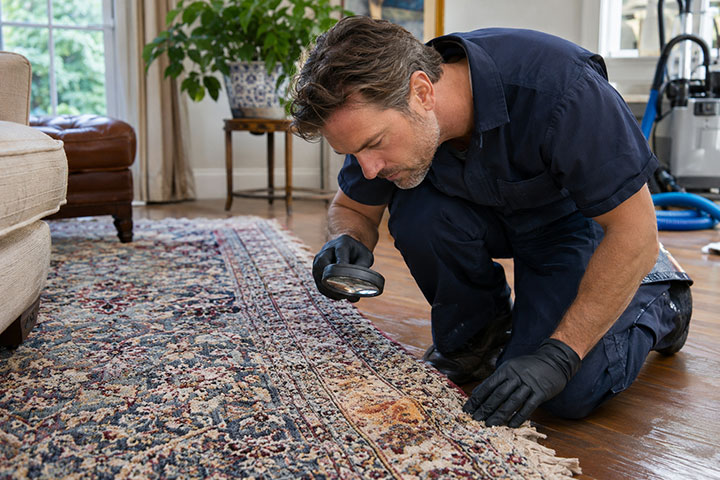
Feet Up Carpet Cleaning of Towson has served local customers since 2005. Our rug-cleaning process begins with an evaluation of the rug's fibers, construction, and condition, followed by selecting an appropriate cleaning method.
A dark spot near a dining table could be a beverage stain. A similar mark beneath a sofa might have a very different history. Examining the surrounding pile, checking the rug's reverse side, and discussing previous treatments help narrow the possibilities.
Technicians assess dye stability in an inconspicuous area before proceeding with a moisture-based treatment. Signs of existing color migration can be significant. Stain removal is only one part of caring for a wool rug. Other signs that a wool rug needs deep cleaning include accumulated soil, lingering odors, and a dull appearance.
The inspection helps establish three practical outcomes:
| Assessment | What It Suggests | Possible Recommendation |
|---|---|---|
| Residue with stable dyes | Stain removal may be achievable | Appropriate professional spot treatment |
| Persistent discoloration | Some visible improvement may be possible | Conservative treatment with realistic expectations |
| Color loss or fragile fibers | Further treatment could worsen the damage | Limited cleaning or no additional stain treatment |
A homeowner in Rodgers Forge contacts us about a hand-knotted Persian wool rug inherited from her parents. After moving the living room sofa, she discovers an irregular pale-orange patch in the rug's blue-gray pattern.
She assumes someone spilled coffee there years ago. During an assessment, the technicians notice that the orange area sits beside a section where the original blue-gray pattern appears faded. The fibers do not feel unusually stiff, but the color difference remains pronounced. The homeowner recalls that an elderly family dog used to rest behind the sofa.
An old pet accident could explain the discoloration, although dye alteration remains a concern.
After considering the rug's condition and testing an inconspicuous area, they recommend a conservative cleaning approach. Off-site cleaning may be suitable because the rug is valuable and its history of moisture exposure is uncertain.
The homeowner is advised that the cleaning may improve the rug's overall appearance, yet the orange patch could remain. The outcome is an improvement, not a complete color restoration. By avoiding aggressive spot treatment, the technicians protect the remaining pattern from unnecessary risk.
A professional cleaner weighs the likely benefit of further treatment against the possibility of harming the rug. A stain that responds well to initial treatment may justify additional work. An old mark accompanied by color loss presents a different situation.
We approach the likely outcome in three broad categories:
An assessment may change the recommendation as new information becomes available. A cleaner's refusal to pursue a stubborn mark indefinitely is not a failure to care for the rug. It can be the most responsible decision available.
An estimate should address more than the rug's dimensions and the price of cleaning. Customers deserve to understand the proposed cleaning approach, the condition-related risks, and the likely limitations of stain removal.
If you own a Persian, Oriental, antique, or sentimental wool rug, mention its age, the stain's history, and any previous treatments when contacting us. Ask what improvement may be realistic. A responsible assessment may identify a stain worth treating, one that can potentially be reduced, or damage that cleaning is unlikely to reverse.

A stubborn mark shouldn't automatically end the useful life of a valuable wool rug. At the same time, complete stain removal isn't always a realistic or safe expectation.
Feet Up Carpet Cleaning of Towson has provided local carpet cleaning and rug cleaning services since 2005. We assess each rug's condition and recommend a cleaning approach suited to its materials and needs.
Call 443-608-5358 to request a free estimate for professional wool rug cleaning in Towson and surrounding Baltimore County communities.
Yes, professional cleaning may still be possible. The technician evaluates the fibers, construction, dyes, and condition to determine a suitable approach. Missing care instructions make identification and testing more important.
Clearing smaller items can make the rug easier to inspect. Tell the cleaner about heavy furniture covering stained or worn areas, and ask about preparation requirements before moving large pieces.
Cleaning may reduce odors associated with accumulated soil or certain contaminants. A musty smell can indicate moisture exposure or microbial growth, which requires further investigation.
Fringe discoloration may result from soil, aging, staining, or previous chemical exposure. Fringe fibers can differ from the rug's pile, and damaged or naturally aged fringe may retain discoloration after cleaning.
You can request an assessment while the affected area is still damp. Explain what happened and mention any products already used. If the spill is recent, avoid experimenting with additional cleaners before receiving useful advice.


